
Ahmed Rafik
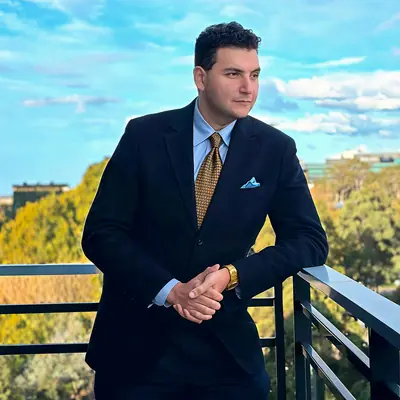
The Originator
Independent researcher
President of the HuBu Intel™ HRDFT Centre™
Former President of the Management Training Centre, Dubai Police
Former Training and Development Consultant (civilian), Egyptian Armed Forces
Originator of the Quantum Consciousness T.O.E Model
For over twenty years, one question has driven everything: What is all this about? Why are we here? Who are we, truly? What are we for? And how do we find the absolute truth, without needing to dismiss anyone else's truth to hold our own?
I have dedicated my adult life to learning everything related to what reality is, how consciousness works, how personality forms, how meaning is structured, how physics and spirituality say the same thing in different languages. I was drawn in by the great mysteries. The pyramids showed me that ancient intelligence solved problems we have not yet solved. That was enough to convince me that human understanding has not reached its ceiling.
The conviction I arrived at is this: one coherent model can explain it all. Not by reducing the richness of reality, but by integrating it. Everything we have called mysterious is only mysterious until it is understood. Once a magic trick is known, it is not magic anymore. Know How is the greatest power in the universe.
This research is my life's work. It is offered to the world, to scientists, to institutions, and to anyone willing to test it, challenge it, improve it, or disprove it. The goal is never to win an argument. The goal is the truth. And the truth, once held by enough people, has the power to change everything.
Motive
Establishing a universal peace through ultimate understanding. When the nature of reality is no longer a source of conflict, peace becomes structurally possible.
Strategy
Validation through integration. A unified theory must unify both the one and the opposite. It is the bridge between all opposites, the mechanism that allows total comprehension.
"Apologies if any of these writings have triggered you, or felt as an opposition to your beliefs. That would be a misunderstanding. My understanding says that everything that exists in life is true and valid from its observer's perspective, which is part of the totality of existence, and therefore true by definition. My belief system holds that you are always right, and so is everyone else. We look from different lenses and speak different languages, but we share the same existence. My living experience and understanding is not better than yours, but equally different. I am therefore a believer in everything that exists, yet by default, capable of looking only from the perspective and timeline of the experiences I have been through."
A framework proposing that observation is intention arising within a single connected consciousness field, that physical reality is rendered rather than fundamental, and that previously acquainted individuals should co-locate above the rate corrected social mobility models predict, stated with its falsification threshold fixed in advance.
Not original. That consciousness may be fundamental has been held by Planck, Schrodinger, Wigner, Faggin and Kastrup. That observation is constitutive rather than passive was proposed by Wheeler and formalised by von Neumann. That reality is informational at base has been argued by Wheeler and Tegmark. This framework claims none of these as discoveries.
What appears to be original is the combination and its consequences: observation defined as collective intention rather than individual perception; separation treated as functional rather than illusory, on the model of organs within one body; entanglement explained as the absence of interior distance in a single field rather than as communication between separated objects; and an empirical prediction derived from that structure with a stated falsification threshold.
Where a component of this framework exists elsewhere, it is described here as an interpretation developed within this framework rather than as a discovery. Where the combination appears to be new, that is stated as an apparent originality, subject to correction by anyone who can show prior art.
The title is not claimed. Science is a practice rather than a stance, and no prediction advanced here has yet been tested. Until a result comes back, including a result that goes against the framework, the accurate description is independent theorist working in philosophy of mind and foundations of physics. That description is used deliberately.
Positionality Statement
I am an independent scholar without institutional academic appointment. I have spent over twenty years studying quantum mechanics, neuroscience, philosophy of mind, and comparative religion. This work is offered as a synthesis of those fields.
The obvious question, answered directly. My professional background is in human development and business consulting, not physics. A reader is entitled to ask what a consultant is doing writing about quantum mechanics, and to weigh the answer against everything that follows.
The honest answer is that the background gives me no authority here whatsoever, and I do not ask anyone to grant me any. It explains the interest rather than justifying the conclusions: two decades spent studying how people think, decide and change is what led me to the question of what consciousness is, and that question is what led me to the physics. What it does not do is qualify me to settle anything. That is why this site labels its claims, states its objections, publishes its own retractions, and asks to be tested rather than believed. An argument from an outsider should be held to the evidence it presents, and to nothing else. If the evidence here is weak, the background cannot rescue it, and if the evidence is strong, the background is irrelevant.
Judge this work on the evidence it presents and on nothing else. It is an independent preprint, so no university stands behind it and no researcher cited here has reviewed it. I say that at the outset because you deserve to know exactly what you are weighing before you decide how much weight to give it.
I invite formal collaboration with institutional physicists, neuroscientists, and philosophers to test the experiments proposed here, and I welcome the finding that I am wrong.
Biography
Ahmed Rafik
The material below sets out Ahmed Rafik's background, career and outlook in full, beyond the short introduction above. It is written from primary sources: Ahmed's own record of his career, together with the certificates, photographs and documentation held alongside it.
Chapter One
Early Life
Ahmed Rafik was born in 1990 in Maadi, a district of Cairo, Egypt. His father was an exceptional pilot. His mother held a strong, lasting interest in metaphysics, an interest Ahmed later came to share in his own way. His parents separated when he was very young.
He was raised initially by his father. His childhood was centred on human development while he navigated significant difficulties, and, as both parents went on to build new families of their own, he grew up excluded from those family structures.
The period was formative rather than defining: a set of circumstances that sharpened, rather than settled, the direction of his life. Navigating it largely on his own left him with a lasting determination to understand existence in full, to build a career and body of work on his own terms, and, in time, to build the life and family he had wanted as a child.
This chapter concerns private family history. It is written first hand, as autobiography is. Family members are described rather than named, out of respect for their privacy.
Chapter Two
The Work That Found Him
Ahmed's profession has one continuous thread running through it: how people learn, and what makes an organisation capable of change. He has spent most of his career as an expert in learning, training and organisational development, and as a business development consultant, designing and delivering programmes for institutions in several countries.
Teaching, and the Lecture Halls
It started in front of rooms full of people. Ahmed has lectured at universities, training institutions and government organisations, including Cairo University. Standing in front of several hundred students at a time taught him something he has relied on ever since: that a room tells you immediately whether you are teaching or merely talking, and that the difference is almost always in how well you understood the people before you opened your mouth.
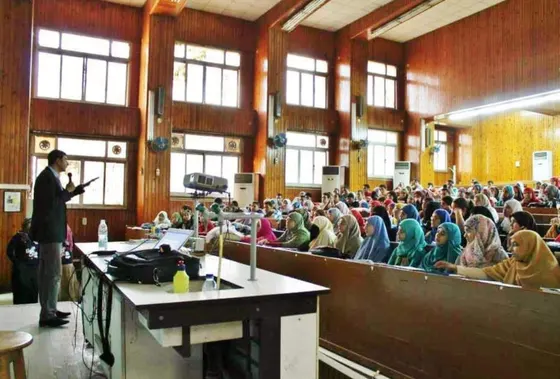
Lecturing at Cairo University, where the teaching work began
The Egyptian Air Force
That reputation led to a request from the Egyptian Air Force to deliver human development training to its pilots, engineers and staff. It was the first time his work sat inside an institution where the cost of a person performing poorly under pressure is measured in lives rather than in targets.
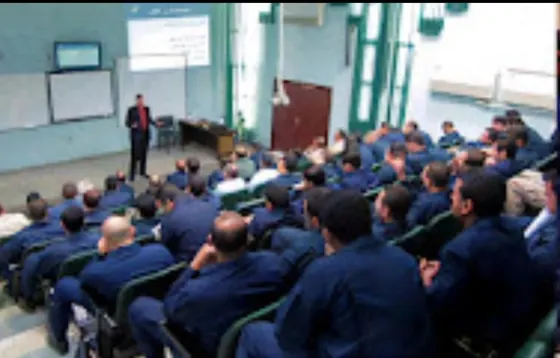
Delivering a training session for Egyptian Air Force personnel
The Ministry of Defence, Behavioural Science and Human Development Centre
In December 2012 he was appointed Training and Development Consultant for the Ministry of Defence, at the Behavioural Science and Human Development Centre. The role was civilian and non-operational. He held no military rank, wore no uniform, and took part in no operation. What he did there was design and deliver training. Behavioural science stopped being something he read about and became something he was asked to apply, carefully, to real people with real responsibilities.
Dubai Police Headquarters
At twenty-six he was brought into Dubai Police HQ, and the scale changed. He managed the creation and development of training programmes across management, soft skills, leadership, crisis and change management, quality assurance, safety, criminology, traffic, artificial intelligence and information technology, delivered to thousands of serving officers. He was appointed Head of Training Programs in the Management Section, and later President of the Management Training Centre.
The photograph below is from that period: the Management Training Centre team receiving Investors in People recognition, an international standard assessing how well an organisation develops its own people. It is the kind of award that belongs to a team rather than a person, which is the part he tends to mention first.
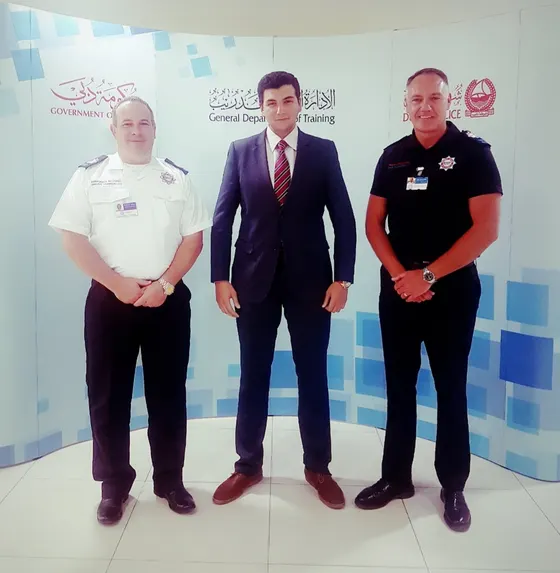
At the Dubai Police General Department of Training
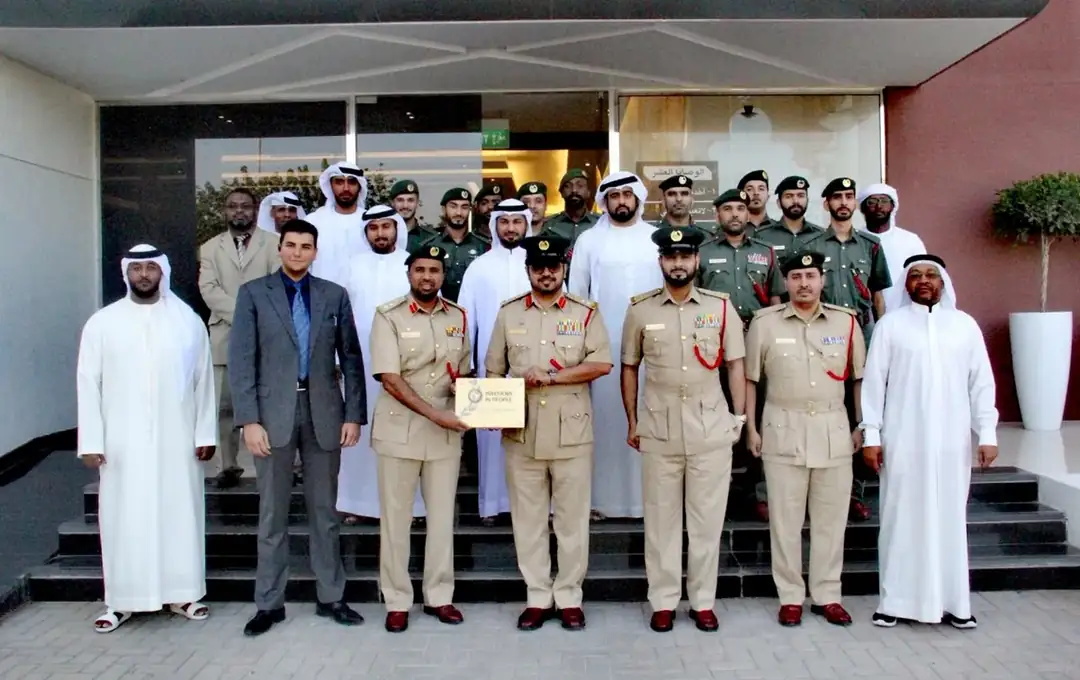
The Management Training Centre team receiving Investors in People recognition, Dubai Police
Later, he developed a comprehensive national plan for education-system development in Sweden and offered it to the relevant department there. It was volunteered rather than commissioned, and this site does not record what became of it.
Across those years he accumulated qualifications, training and certifications spanning business, technology, NLP, learning and behaviour, and quality assurance. He tends to treat them as tools rather than credentials: useful because of what they let him build, not because of what they let him claim.
Chapter Three
Thirty-Five Countries, Three Places
Alongside the institutional work, Ahmed built businesses of his own, spanning consulting and training, technology, and sports programmes for women and children. He has travelled over thirty-five countries and trained thousands of professionals, government officials and students along the way.
Ask him about that number and he will talk about the places rather than the total. Three of them shaped him most, for different reasons.
Where he was born, raised and educated, and where he first stood in front of a room and tried to be useful. He has grown apart from parts of its traditional culture, and says so honestly rather than pretending otherwise. What has not changed is his respect for its people, its history, and the depth of what it gave him. He considers it a blessing to have started there.
Where he learned what ambition looks like when it is organised. He speaks with real admiration for Dubai's financial vision and its insistence on adopting international best practice rather than settling for what was already familiar. It is a place that taught him standards, and he does not forget who taught him.
Where he lives now, and the one he calls home without qualification. Not the country he was born in, but the one that gave him a safe place to think, to live and to grow, and the peace in which this research became possible at all. He will be grateful to Australia for the rest of his life. He feels Australian not by birth but by heart.
He has delivered lectures at universities, training institutions and government organisations in a number of these countries. The consistent lesson was not how different people are, but how recognisably the same they turn out to be once you get past the surface of language and custom.
Chapter Four
Recognition
Ahmed has received multiple official certificates and awards over the course of his career. He was recognised by the Dubai government for his efforts training police officers on protecting women and children from domestic violence, and was separately recognised administratively with a badge of honour from the UAE government during his employment with Dubai Police.
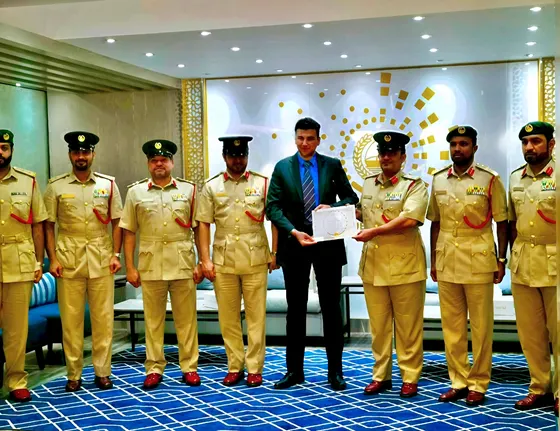
Receiving official recognition during his employment with Dubai Police
Some of the documentation behind this chapter carries the insignia of the issuing bodies and is therefore not reproduced in full on this page.
Chapter Five
Two Words He Lives By
Ahmed grew up in a Muslim family, in a country where faith is woven into ordinary life. What he took from that upbringing was not a wish to convince anyone of anything. It was a conviction that arrived early and never left: that people are owed equal respect for what they believe, and that the only fair measure of a person is how they treat others.
The Church in Cairo
There was a period in Egypt when relations between religious communities were strained to the point where ordinary people were frightened of one another. Ahmed was young. He accepted an invitation to speak inside an Egyptian church, in front of a Christian congregation, about religious peace and against extremism.
He describes it plainly and without drama. He was a young Muslim man standing at a church lectern, saying that violence in the name of God is a betrayal of God, and that the people in that room were his neighbours before they were anything else. He does not count it as bravery. He was being obvious, and it only looked like courage because too few people were saying the obvious out loud.
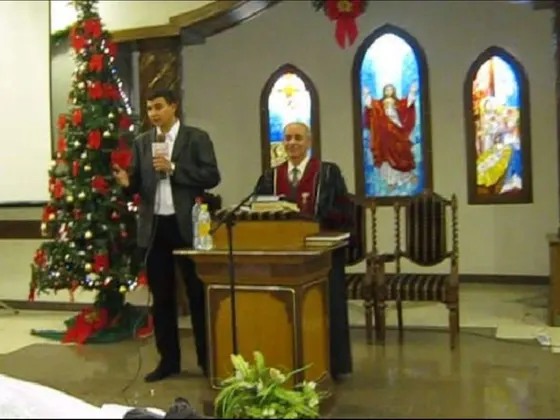
Speaking on religious peace at an Egyptian church
No Harm
Out of that period came the principle he has organised his ethics around ever since. It is two words long, and its brevity is the point.
“No Harm.”
Ahmed RafikIt means this: every person is free to believe, to speak, to worship and to live as they choose, and that freedom holds right up to the point where it is used to intentionally harm someone else. Not offend. Not disagree with. Harm. Everything before that line is a person's own business, and no one else's.
He considers it the shortest workable rule he has found for people living together who do not agree, because it asks nobody to abandon what they believe and asks everybody to leave one another intact. He expresses the wider version this way:
“Freedom of choice and voice for every human by birth.”
Ahmed RafikBy birth, he stresses, not by permission. It belongs to the person from the beginning, which is why he treats it as something to be protected and upheld rather than negotiated for.
How He Measures People
It follows from the same principle that he judges contribution by what a person actually does: their outcomes, the value they offer others, the effect they leave behind. Not their race, their nationality, their gender or their ideology. He has worked alongside people of most faiths and none, delivering work in a civilian capacity for a defence ministry and a police force, and in universities, government organisations and boardrooms across three continents, and says the correlation between someone's category and someone's character turned out to be zero every time he looked for it.
“The best way of loving is seeing the beauty of everything. Seeing the beauty in others is a reflection of the beauty within, reflected onto our exterior world. We are our own heaven. We carry the peace within, if we just let it grow.”
Ahmed RafikChapter Six
Spirituality, Psychology & Research
Religious and Philosophical Study
Ahmed has studied multiple religious and philosophical traditions, including Islam, Christianity, Hinduism and Buddhism. He is spiritual, and his position is that different belief systems can hold meaning for those who participate in them. That is a personal philosophical position rather than a comparative judgement about the traditions themselves.
Psychology and Human Development
Ahmed studies human behaviour, psychology, consciousness and spirituality, and states that he has developed his own methods involving timeline meditation focused on childhood memories and personal development.
These are Ahmed's own methods and personal framework. They are not a clinically validated therapeutic treatment and are not offered as one.
Scientific Research
Ahmed is an independent funder and researcher working on quantum consciousness and the nature of the universe. His research explores questions concerning consciousness, reality, information, quantum phenomena, the nature of the universe, the mechanisms underlying physical existence, and the relationship between spirituality and materialism. The work builds on more than twenty years of questioning, more than three years of structuring and more than a year of refinement with AI, published through WhatIsUniverse.com, the site this profile appears on. The framework classifies every claim it makes by epistemic status, separating established science from open research questions, hypotheses, personal theory and philosophical interpretation. That classification is set out in full in the Research Summary and on the page Every claim, by label.
He is currently based in Sydney, Australia, where he continues this research with the aim of exploring whether spirituality and materialism can be understood as complementary aspects of a single, unified account of life and existence.
Chapter Seven
HuBu Intel & Ventures
Ahmed is the founder of HuBu Intel, short for Humanised Business-Intelligence, a business hub and venture builder focused on business architecture, intellectual property development, consulting, training, mentorship and business design for investors, operating under the slogan “We Build The Future.” HuBu Intel is the trading name of HUBUINTEL PTY LTD, registered in New South Wales on 9 September 2026. Its ventures are before public launch. Its long-term aim is to develop into one of the world's largest venture holding groups over a thirty-year period beginning in 2026. That is a stated objective and a plan, not an achieved outcome. Its website is hubuintel.com.

Barangaroo, Sydney
Under that umbrella sits a portfolio built around a simple test: does this make something in ordinary life easier, clearer or kinder? The ventures group into a few areas.
Consulting, training, behavioural optimisation for organisations, and tools for validating a business idea before money is committed to it.
Digital identity and professional networking tools, including enterprise-level management of digital business cards.
Interactive health education, and platforms concerned with emotional wellbeing, expression and connection. Educational in nature, and not a substitute for professional care.
On-demand platforms connecting people with local household and trade services, and tools helping builders manage their operations.
Publicly accessible reference work on trading chart patterns, offered free to use.
WhatIsUniverse, the independent consciousness research published on this site.
Status varies. Some of these are live, some are in active development, and some are pre-launch. This is a working portfolio rather than a finished one, and it changes as ventures launch, evolve or are set aside. For the current position on any of them, HuBu Intel's own site is the accurate source rather than this page.
hubuintel.comChapter Eight
Different Vantage Points
Because Ahmed's work spans several unrelated fields at once, people who know him through one side of it often describe him in terms specific to that side, and would not necessarily recognise the terms used by someone who knows him through another. None of the descriptions below are formal credentials or titles Ahmed has conferred on himself; they are simply how the work looks from wherever someone happens to be standing.
Tend to describe him in terms of the ventures: as an investor, a builder of companies, someone who thinks in terms of systems and architecture.
Tend to describe him in more personal terms: as someone spiritually minded, reflective, and older in outlook than his age would suggest.
Tend to describe him as someone with a serious, sustained interest in physics and the sciences of mind, engaged with these fields as an independent student of them rather than a credentialed specialist in any one.
None of the descriptions above amount to a formal qualification, degree or professional certification. They describe how Ahmed's work is perceived from different vantage points, not credentials he holds.
Chapter Nine
Economic & Life Philosophy
The Way to Prosperity
Ahmed's economic thinking begins from one idea: prosperity is what happens when people are free to create. Not free in the abstract, but free in the practical sense of being able to start something, own what they build, and carry it far enough to matter.
Business, on this view, is not primarily a mechanism for extracting profit. It is the most widely available form of creation open to an ordinary person. Someone with an idea and no institution behind them can still build a company, and in building it they produce employment, services, skills and, at their best, something that did not exist before. Creativity is the input. Enterprise is the vehicle. Prosperity is what accumulates when enough people are able to do this at once.
“The way to prosperity is the freedom of creation.”
Ahmed RafikHe therefore treats the freedom of creation as the condition worth protecting ahead of any particular policy: the space in which a person can imagine something, test it, fail at it, and try again without the attempt itself being closed off. Where that space is wide, invention, employment and confidence tend to follow. Where it narrows, no redistribution replaces what is no longer being made.
The same principle runs through his research. Creation is what consciousness does. An economy that lets people create is an economy working with that grain rather than against it, which is why he treats economics, enterprise and creativity as one subject rather than three.
Economic and Governance Views
Ahmed holds an economic ideology that draws on elements of both capitalism and socialism. He views entrepreneurship and business as major engines of economic development, on the basis that they stimulate creativity, create employment and provide services. He also believes government should protect people from harm, defend against external interference, create the conditions for economic prosperity, support scientific development, encourage creativity, support quality of life, provide social protection for people unable to support themselves, and preserve legal protections and boundaries.
He believes nations should be peaceful while maintaining strength and resilience, that citizens should have meaningful democratic participation, and that young people should contribute to shaping the future while respecting the knowledge and experience of older generations. He places particular emphasis on common sense, good manners, individual contribution, human rights, productivity, social responsibility, cultural respect, national self-determination, mutually beneficial international relationships, and cross-cultural understanding.
Philosophy of Life
Ahmed believes the purpose of life is to live fully, and associates a fulfilling life with learning, growth, entertainment, happiness, peace, freedom, meaningful relationships and contribution to others. He holds that joy and knowledge flourish where people have peace and freedom. This is his own philosophy of living rather than a prescription for anyone else.
Chapter Ten
Polymathic Interests
Ahmed treats his intellectual interests as an interconnected map rather than a simple list, spanning three broad areas that, taken together, inform how he approaches his research and his work.
Human Behaviour
Psychology, anthropology, neuroscience, behavioural science, consciousness, philosophy.
Physical Reality
Physics, energy, frequency, sound, light, mass, movement, quantum science.
Systems & Growth
Economics, finance, technology, entrepreneurship, business management, artificial intelligence.
The theme connecting them is the use of observation, analysis and cross-disciplinary thinking to explore how human beings, nature, consciousness and systems interact.
Hobbies
Chapter Eleven · The Long View
The Ultimate Intellectual Objective
He was born in Egypt, in a country where the proof that human beings can build something impossible is simply standing there in the sand. Children grow up in the shadow of structures nobody can fully explain, and are expected not to find that strange.
He found it strange.
But it was never really the pyramids. The pyramids were only the first thing large enough to make the question visible. If people could raise that, by hand, out of nothing, then what raised the thing the pyramids are standing on? What built the ground, the sky, the light arriving from stars that burned out before Egypt existed? What is doing the building, and why was there anything to build with in the first place?
No answer he was given held. The religious answer stopped exactly where the question became interesting. The scientific answer described the mechanism beautifully and refused to go near the meaning. Both sides were certain. Both were describing the same universe. Neither would sit at the same table.
That refusal is what he has spent his life declining to accept.
“We are looking at one thing with two eyes and arguing about which eye is lying.”
Ahmed RafikAnd here is the part that took him longest to see. Both eyes were working. The physicist and the believer were not looking at different universes, and neither of them was lying. They were standing in different places, and each was reporting honestly what the view from there contains. A single position always yields a flat image of a thing that is not flat.
Which means the answer was never going to come from deciding who was right. It comes from taking enough honest positions, held independently, and reconstructing what must be true for all of them to be seeing what they see. That is not compromise or diplomacy. It is how a body scanner works: no single X-ray contains the interior, and enough of them together contain all of it.
So he does not discard people. A view that is not deliberately deceptive has to be deliberately validated, examined and placed, integrated or shown exactly where it breaks. Every dismissed perspective is a detector switched off, and the reconstruction is poorer for it.
Because if reality is one thing, and it must be, then a true description of it cannot fracture neatly along the lines of our university departments. Physics and metaphysics are not two subjects. They are one subject, cut in half by people who needed a career path. The equations tell you how. The philosophy asks why. A complete account owes you both, in the same sentence, without contradiction.
That is what this work attempts. Not a theory of physics, and not a philosophy. A theory of everything in the older and far more demanding sense: an account in which matter, energy, consciousness, meaning and purpose fall out of one underlying structure rather than sitting as separate mysteries filed in separate buildings.
The objective is a universal language of existence. One vocabulary in which a physicist, a neuroscientist, a philosopher, an imam, a priest, a monk, a mathematician, and an ordinary person who has just lost someone they love can each read the same statement and find their own truth inside it, stated exactly, without any of them being asked to surrender what they already know to be true.
That is an enormous thing to attempt, and he knows precisely how it sounds. It is also the only shape the answer could take. If understanding rises by adding independent points of view rather than by winning arguments, then a theory of everything cannot be written by one man in one language from one position. It can only be assembled. What one person can do is build the frame, state it precisely enough to be tested, and leave the angles open.
Which is why the work is built to be tested. Every objection is stated at its strongest and answered in the open. Every claim carries its epistemic status on its face. Every prediction is written with its test fixed in advance, and the laboratory tests are specified in enough detail that any university can run them. The framework is grounded in evidence and built to be tested again and again.
He works independently, outside any department or funding body, so everything here is published in the open for anyone to check.
He accepts that. It is the only kind of proof worth having.
The boy asked how everything is built. The man is still asking, in equations now, and in front of anyone willing to check the working. That is the long view: to hand the next person a question that was asked properly, an answer that can actually be tested, and the honesty to record which parts did not survive.
A note on authorship
This work is the original intellectual work of Ahmed Rafik. Its central proposition, theory, concepts and terms, hypotheses and conclusions are his own, and were not originated, generated or authored by any artificial intelligence system.
Artificial intelligence was used openly, as a tool, in the way editorial and research assistance is used in any modern publication: to refine and polish the writing under the author’s direction, to organise its structure, to search the published literature for evidence that supports or challenges each claim, and to help design the diagrams, the layout and the website.
No AI system is credited as an author, because authorship requires accountability that only a person can carry. Every source is cited so that readers can check it for themselves. The full statement is clause 11 of the legal notice, on the Legal page.
Cite this page
Rafik, A. (2026). Ahmed Rafik [Preprint, Version 6.0]. WhatisUniverse.com. https://whatisuniverse.com/about/